Intracranial Internal Carotid Artery Wall Calcification in Ischemic Strokes Treated With Thrombolysis
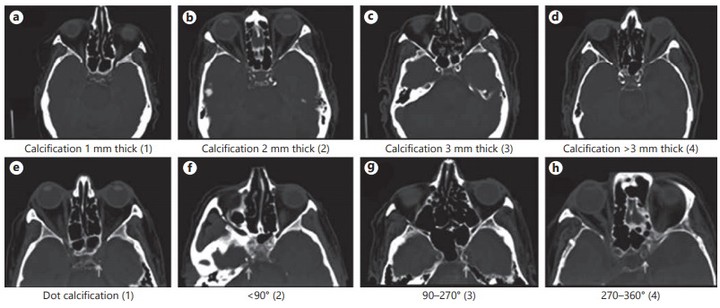 Total Carotid Siphon Calcification in the carotid siphon. The Calcium Thickness Score (a–d) was determined by the point of maximum thickness of the calcified wall of the intracranial carotid. A Calcium Extent Score (e–h) was ascertained utilizing a scale based on the circumferential extent of calcium deposition in the intracranial segment of the internal cerebral artery. The petrous, cavernous, ophthalmic, and communicating internal carotid segments were considered in the analysis, and the section with the most conspicuous disease was graded.
Abstract
Background: Calcifications are an important element of atherosclerotic plaques and have been used as a marker of atherosclerosis and clinical outcome predictor in different vascular territories. CT-scan, performed in the acute ischemic stroke setting, can reliably detect intracranial arterial calcifications.
Objectives: To investigate the association between intracranial internal carotid artery calcification and functional outcome, symptomatic intracerebral hemorrhage (sICH), recanalization, and death.
Methods: We included 396 consecutive ischemic stroke patients submitted to recombinant tissue plasminogen activator treatment between January 2011 and September 2014. Admission CT-scans were reviewed to calculate the Total Carotid Syphon Calcification score. Patients were followed for up to at least 6 months post-stroke or until death. Outcome measures included evaluation of recanalization on the first 24 h (transcranial color coded Doppler or angio-CT), sICH, and assessment of functional outcome at 3 months after stroke (using modified Rankin scale).
Results: Carotid artery wall calcification did not predict sICH, recanalization or any good outcome. However, it was a statistically significant predictor of death (OR 1.102, 95% CI [1.004-1.211], p = 0.042).
Discussion: Intracranial carotid artery calcification does not increase the risk of thrombolysis-induced sICH. Patients with higher grade of carotid artery wall calcification may have a higher mortality rate.
Keywords: Calcification; Carotid; Hemorrhage; Outcome; Stroke; Thrombolysis.